
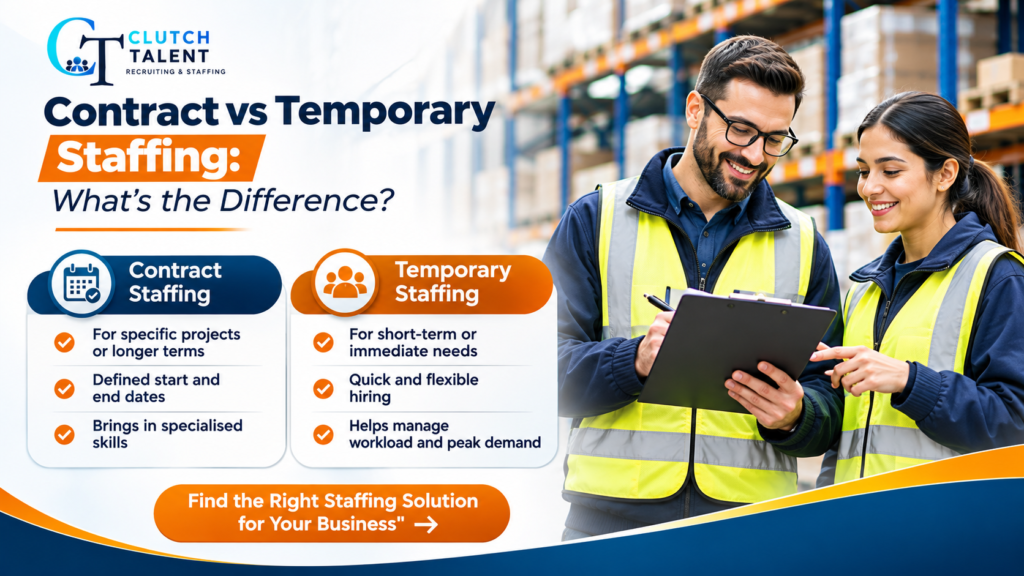
“Contract” and “temporary” staffing are often used as if they mean the same thing. They overlap, because both bring in workers for a limited period, but agencies and employers usually use them for different situations. Knowing the difference helps you ask for the right thing and plan your budget.
The short answer: temporary staffing usually covers short-term or unpredictable needs, such as peaks, absences and urgent gaps, often in high-volume roles, with workers who can start quickly. Contract staffing usually fills a role for a defined period or project, often several months, and often for a more specific skill set. The terms aren’t legally defined the same way everywhere, so always agree the length, duties, pay and conversion terms in writing.
Side-by-side
| Temporary staffing | Contract staffing | |
| Typical length | Days to a few months; often open-ended or variable | A set term or the length of a project, often several months |
| Typical trigger | Peak volume, absence, sudden turnover | Project, implementation, backfill for a known period |
| Typical roles | General labour, warehouse, production, admin support | Skilled or specialised roles, supervisors, technicians, project roles |
| Planning | Can be arranged at short notice, depending on supply | Usually planned in advance with a clear scope |
| Volume | Often several workers at once | Often one or a few people |
| Who employs the worker | Usually the agency, as a temporary help agency | Usually the agency; sometimes the worker is an independent contractor. Confirm in your agreement |
| End of engagement | When demand drops or the assignment ends | At the end of the term or project |
What is contract staffing in recruitment?
In recruitment, contract staffing means an agency finds and supplies a worker to fill a role for a fixed term, rather than permanently. The agency usually handles sourcing and screening and, in many arrangements, employs the worker and runs payroll. The client directs the day-to-day work.
A typical contract staffing process looks like this:
- Define the role and term. Duties, skills, start date, expected end date, location and hours.
- Agree terms with the agency. Rate, who employs the worker, conversion terms and notice.
- Sourcing and screening. The agency shortlists candidates who match the skill set.
- Interview and select. You meet the shortlist and choose.
- Onboarding. Site orientation, safety training and equipment.
- Review and extend or end. At the end of the term, extend, convert to permanent, or close the contract.
When temporary staffing fits better
- Volume changes week to week, for example in a fulfilment warehouse.
- You need people quickly to cover absences.
- The work is learnable on site in a short time.
- You’re testing a new shift before committing.
See our peak season staffing timeline for planning ahead of busy periods.
When contract staffing fits better
- The need has a clear end date, such as a project, a system rollout or covering a leave.
- The role needs specific skills, such as a maintenance technician or a shift supervisor.
- Continuity matters for the whole period, so one person staying for the full term is important.
What about temp-to-hire?
Temp-to-hire starts as a temporary or contract assignment, with the possibility of a permanent offer. In Ontario, if the worker is employed by a temporary help agency, the agency can’t stop you from hiring them directly. A fee can generally apply only within six months of the worker’s first day with you through the agency. See Temporary Staffing vs Permanent Hiring.
Ontario rules apply to both
If the agency employs the worker and assigns them to you, it’s acting as a temporary help agency under Ontario’s Employment Standards Act, whether you call the arrangement “temporary” or “contract”. That means the agency must be licensed, and you have client obligations such as keeping records of the worker’s hours. See Using a Temporary Help Agency in Ontario.
If a worker is engaged as an independent contractor instead, different rules apply, and misclassification carries risk. Get advice if you’re unsure.
Frequently asked questions
Is contract staffing the same as temporary staffing?
They overlap. Temporary staffing usually covers short-term or unpredictable needs; contract staffing usually fills a role for a defined term or project, often with more specific skills.
How long does a staffing contract usually last?
It depends on the role and project. Agree the expected term in writing at the start.
Who employs a contract worker?
Often the agency employs the worker and assigns them to you. In some arrangements the worker is an independent contractor. Check your agreement.
Can I hire a contract worker permanently?
Usually yes. If the worker is employed by a temporary help agency in Ontario, the agency can’t stop you; a fee may apply within the first six months.
Does the agency need a licence for contract staffing?
If it employs workers and assigns them to clients in Ontario, it’s a temporary help agency and needs a licence.
Talk to Clutch Talent
Clutch Talent offers both temporary staffing and contract staffing for warehouse, general labour and production roles in Brampton and the GTA . Tell us about your requirement.
General information verified 6 November 2026 against Ontario Ministry of Labour sources. Industry use of “contract” and “temporary” varies. This is not legal advice.