
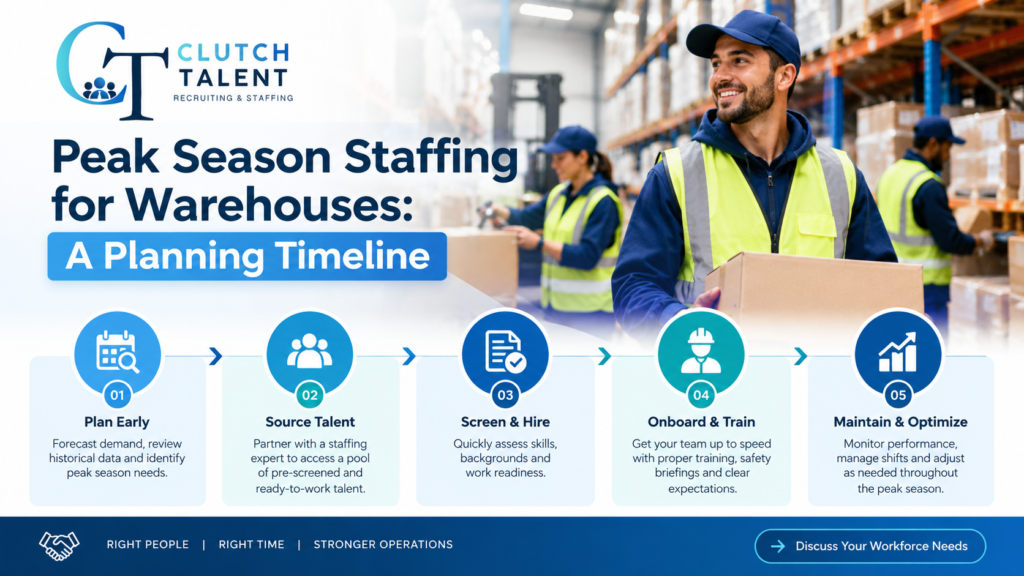
Peak season rarely arrives as a surprise. Order volumes for many warehouses in the GTA rise around the holidays, promotional events or a customer’s product launch. Yet staffing for those peaks is often left until the work is already piling up. The result is overtime, rushed hiring and new workers learning the job on the busiest days of the year.
This guide sets out a practical timeline for planning seasonal warehouse staffing, from forecasting through to the post-peak review. Use it as a starting point and adjust it to your operation.
What seasonal staffing means for a warehouse
Seasonal staffing means adding workers for a defined period of higher demand, from a few weeks to a few months. In a warehouse or distribution centre, that usually means extra:
- Order pickers and packers
- Shipping and receiving support
- Material handlers and general labour
- Lift-truck operators, where the role and the worker’s training allow it
The aim isn’t simply more people. It’s the right number of people, with the right skills, on the right shifts, ready before demand peaks.
The planning timeline
| When | What to do | Outcome |
| 10–12 weeks before peak | Review last year’s volumes, overtime and attendance; forecast by role and shift | A staffing requirement you can share |
| 8–10 weeks before peak | Decide which roles to fill with temporary staff, which with existing staff or overtime, and which (if any) need permanent hires | A clear staffing mix |
| 6–8 weeks before peak | Send detailed worker requests and confirm site requirements, such as PPE, training and start times | Recruiters can source against real requirements |
| 3–5 weeks before peak | Confirm start dates; prepare orientation, safety training and supervision | Workers ready to start |
| 1–2 weeks before peak | Start the first workers before the busiest days; check attendance and fit | Time to adjust before peak |
| During peak | Track attendance, productivity, overtime and safety daily | Early warning of gaps |
| After peak | Review what worked; record lessons for next year | A better plan next season |
These timings are a general guide. If you need many workers, need specialised skills such as trained lift-truck operators, or have a long site onboarding process, start earlier.
Step 1: Forecast demand by role and shift
Start with your own data:
- Order or unit volumes in last year’s peak, week by week
- Hours worked and overtime by department
- Attendance and turnover during the peak
- Any changes this year, such as new customers, new lines or a new building
Turn that into a requirement such as “12 additional pickers on the evening shift from 16 November to 3 January” rather than “more staff”. A specific requirement is easier to plan for, and easier for a staffing partner to fill.
Step 2: Choose the right staffing mix
Not every gap needs a new hire.
| Option | Often suits | Watch for |
| Overtime for existing staff | Short, small spikes | Fatigue, errors and cost if it runs for weeks |
| Temporary workers | Defined peak periods | Onboarding and supervision time |
| Contract workers | Fixed-term projects with a clear end date | Clear scope and dates |
| Permanent hires | Demand that will continue after peak | Longer hiring process |
See Temporary Staffing vs Permanent Hiring for Warehouse and Production Roles for a closer comparison.
Step 3: Make detailed requests early
The more specific your request, the better the match. Include the role, number of workers, location, shift, start date, expected duration, main duties, required experience, mandatory training or certifications, and PPE. Our worker request checklist lists everything to include.
If you use a temporary help agency, check that it’s licensed. Since 1 July 2024, Ontario requires temporary help agencies to hold a licence, and clients must not knowingly use an unlicensed agency. You can check an agency’s status on the Ontario Ministry of Labour’s public status page.
Step 4: Plan onboarding and safety before day one
New workers need to be productive and safe quickly. Before they arrive:
- Prepare a short site orientation: layout, emergency procedures, reporting hazards, break times and who to ask for help
- Confirm any job-specific training, such as lift-truck operation, and who is responsible for it
- Assign an experienced buddy or lead hand for the first shifts
- Have PPE ready
- Give clear written instructions for each task
Responsibilities for training and safety between a client and a staffing agency should be agreed in writing before workers start.
Step 5: Monitor during peak
Track a few measures daily:
- Attendance and late starts
- Units or orders per hour by shift
- Overtime hours
- Safety incidents and near misses
- Open positions
If demand rises beyond forecast, request additional workers early rather than stretching your existing team further.
Step 6: Review after the rush
Within two weeks of the end of peak, review:
- Whether the forecast was accurate
- How long it took to fill each role
- Which workers performed well (and whether any could be offered more work)
- What onboarding steps helped or slowed things down
Write the lessons down. They become next year’s starting point.
Common mistakes
- Starting too late. Requests sent in the first busy week compete with every other employer.
- Vague requests. “We need people” is hard to fill well.
- Skipping orientation. It costs more in errors and injuries than it saves.
- Relying on overtime alone. Long peaks wear teams down.
- Not planning the end date. Be clear about expected assignment length from the start.
Frequently asked questions
When should a warehouse start planning for peak season?
Ideally 10–12 weeks before demand rises, and earlier for large or specialised requirements.
How many temporary workers will we need?
Base it on last year’s volumes, productivity per worker and this year’s changes. Plan by role and shift rather than as a single total.
Can temporary workers become permanent employees?
Often, yes. Under Ontario’s Employment Standards Act, a temporary help agency can’t stop a client from hiring an assignment employee directly. Discuss your plans with your agency up front.
What should we check before using a staffing agency in Ontario?
Confirm it holds an Ontario temporary help agency licence, and agree in writing who is responsible for training, safety and payroll.
Plan your peak season with Clutch Talent
Clutch Talent supports warehouse and logistics employers in Brampton, Mississauga and across the GTA with temporary and seasonal workers. [CONFIRM: service area] Tell us your roles, shifts and start dates, and we’ll explain how we can help.
Request Workers · Warehouse and logistics staffing · Temporary staffing